Friday, February 17, 2012

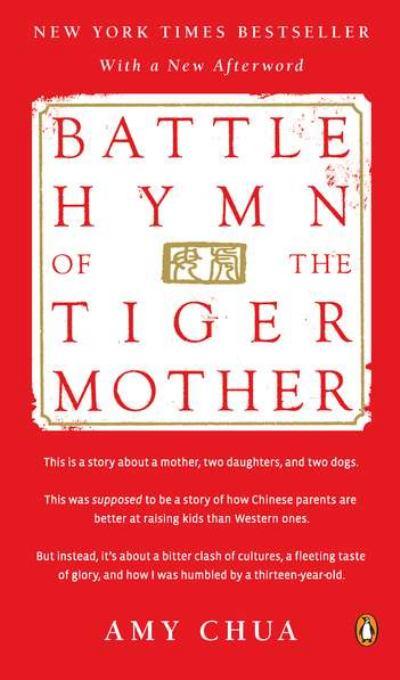
Battle Hymn of the Tiger Mother, by Amy Chua


Let me preface this entry by saying I don’t want kids.  I would be a horrible mother – I’m selfish, over-educated, and stubborn; this would result in me not having the patience to accommodate my life around children, an inability to connect with anyone lacking in even the most basic of education, and an unwillingness to unbend.  All in all, a horrible combination.  These are things I’ve recognized and acknowledged in myself for the last 3 or 4 years and I’ve accepted them, and I will staunchly defend my position to any and all who care to listen to them with an open heart.  (Which are very few.  Check out this Maclean’s article for an assessment of why that is…)

Regardless of all that, I have some very firm beliefs on how I would raise children if I were forced into that situation (and I’m perfectly willing to acknowledge that if it were the deal-breaker in an important relationship, I might unbend.  But it’s unlikely.)  As clichéd as it is to say, kids today suck.  Parenting has taken some mighty big blows in Western society over the last decades.  Seemingly gone are the parenting techniques of when I was a child which included: “You have two choices – you can do it was a smile, or you can do with a frown, I don’t care which,” “Because I said so, that’s why,” and the most common “NOW, OR ELSE!”  I never had a video game (I read instead), I lost TV privileges when my spelling tests came back poor (and they often did), and I learnt how to cook and do laundry before the age of 10.  And for a lot of my childhood, I was miserable.  But now, I’m a highly educated and self-sufficient woman.  (I still can’t spell though.  There was nothing that was going to fix that.)

There are consequences to how I was raised, however.  I never had a great relationship with my mother, and it’s broken down to being almost non-existent recently.  I recognize that my desire not to have children is a rationalization of my own childhood experiences.  In some ways that makes me sad, in other ways it makes me proud that I’m breaking an unhealthy cycle.  All of this is to say that Amy Chua, the self-professed “Tiger Mother”’s memoire struck a strong note with me, and gave me hope that some of the upcoming generations of kids might not make horribly shitty adults.  SOME – not all.

Amy Chua, author of Battle Hymn of the Tiger Mother, is the daughter of first-generation Chinese immigrants to America.  Her own childhood was based (from my impressions) on living up to their expectations.  She describes an award ceremony at school that her parents attended where she placed second; on their way home, her father told her “Never shame me like that in public again.”  This exchange may be shocking for a Western reader, but think back to all the “participation” awards you got as a kid that are worth nothing.  Mr. Chua expected and demanded the best from and for his kids, not a token acknowledgement that they didn’t come in first – and maybe he was right.  Life doesn’t hand you awards for showing up – you have to try hard to get anything.  My landlord isn’t going to accept a “thank you for your interest, but you didn’t get the job” letter rather than rent money.  I read an article a few years ago about British school children; rather than getting Fs on report cards, teachers were marking them with “Deferred Success.”  Come on.  That’s not doing anyone any favours in the long run.  Those kids are going to grow up thinking that there are no consequences for being failures, and that’s simply not the truth.  Amy Chua learnt that lesson from her own childhood, and set out to impart it on her own children.

I can see why many people would view Chua’s parenting technique as extreme and ill-advised.  There were aspects that made me cringe, and I’m the person who advocates for fear-based parenting techniques when talking with friends who have kids.  Forcing small children to practice musical instruments for hours on end, calling them names when they disappoint you (which sounds worse than it is – you should really read the book for context, and no, I’m not saying the kid deserved it, just read the book), and rejecting home-made birthday cards because they were clearly slapped together at the last minute all seemed a little extreme and unnecessary to me.  But then I think, “Hey – Amy Chua has raised two children.  She raised them to be smart, determined, charismatic, and extremely talented.  What do I know?”

Her daughters, as depicted in the memoire, are going to be forces of nature when they’re grown women.  Sophia, the oldest, is the piano virtuoso.  But she’s much more than that.  Her mother included several passages of essays and speeches that Sophia wrote and I was blown away.  I had a fleeting thought that Chua must have edited them to make them so fantastic, but then realized that she respects her daughter too much to have done that.  Rather, Sophia has a natural talent and wit for self-expression, and I think I’ll be checking out her blog shortly!

Lulu (Louisa) proved to be her mother’s biggest challenge in life (well, that’s the impression I got).  But nothing worth having in your life isn’t worth fighting for.  Lulu comes across as obstinate, but in the best possible way; even as a young girl, she knew her own mind and never backed down from a position.  I’ve gotten flack for a similar (if not quite so fierce) mentality over the years, but in this dog-eat-dog world, it serves a woman well.  Lulu may not have taken the road her mother put her on and wanted her to take, but there’s no doubt in my mind that wherever Lulu wants her road to go, she’ll get there.  And she’ll get there in style.

Amy and her husband Jed should be (and I’m sure are) extremely proud of their girls.  What Chua’s book does is not lay out a how-to manual on raising your children in the Eastern fashion in the Western world.  Rather, the conclusion of the book finds that this is almost impossible – you can adopt the model, but the variables (i.e. the children) dictate the outcome.  

Chua was incredibly brave in writing this book – she took a lot of flack for it.  Parents who ‘raise’ their children apologetically by asking what they want to learn at school, or how they feel about breaking something, or when they want to go to bed seem to outnumber the Tiger Moms of this world.  And the apologetic parents are loud about anything that runs counter to their world view.  Chua stepped out from behind closed doors and illustrated how to do it differently (and, dare I say, better?).

Chau’s book doesn’t make me want to go out and procreate to I can try the Tiger Mom method.  If I ever do have children, I think I would try to strike a balance between my own up-bringing (which was more badger- than tiger-like) and Chua’s.  Demanding the best from kids, while also being kind and gentle seems the way to go.  But, this is Monday morning quarterbacking, and I’m sure Chau would be the first one to admit that hind-sight is 20/20, and no one, not even a Tiger Mom, can write a how-to manual on child-rearing.  

Final verdict?  Read Battle Hymn of the Tiger Mother.  It’s touching, witty, and clever in its humanity.  

Monday, February 6, 2012

The Harper Connelly Series, by Charlaine Harris


Charlaine Harris is a busy little literary bee!  Probably best known for her True Blood series, Harris is also the author of several smaller runs of books, such as the Harper Connelly stories: Grave Sight, Grave Surprise, An Ice Cold Grave, and Grave Secret.  I spent my weekend with Harper, and found that lightning didn’t just strike once for Harris (and those who know the books will get that joke), but rather, the ability to write solid series of books is a skill she holds firmly in her wheelhouse.

The Harper Connelly series follows Harper and her brother across the country while they make a living off of Harper’s unique skill.  Ever since she was a teenage, Harper has been able to ‘hear’ dead people.  Well, it’s not so much hear, as sense.  Harper is able to locate bodies (from ancient to modern origins), tell you who they were, and what they died from.  Harper makes her living giving families closer at gravesides by confirming COD, or by searching for missing people/bodies.  While Harper is the skills of the operation, she’s assisted by her step-brother Tolliver, who acts as her manager and caregiver.  (Hey, communing with the dead is draining on a girl!)

I’m finding there are two enjoyable characteristics that run through all of Harris’ works.  The first is an ingrained sense of humour.  It’s not laugh-out-loud funny, but it’s a satirical and tongue-in-cheek kind of funny.  It’s dry and witty, and incredibly enjoyable to someone of a similar sensibility.  The second recurring pattern to Harris’ works is the supernatural and macabre which are the basis of her works.  True, there were no vampires or shifters in the Harper books, but there were plenty of dead people, souls, psychics, and one ghost.  Harris’ ability to make these seemingly impossible creatures (to us skeptics, at least) seem possible and, better, plausible, is fabulous, and it shows her strength as an author.

On this series in particular: There was one aspect that left me a little rocky after the first book, and unsure if I would like the rest.  That aspect is the relationship between Harper and Tolliver.  In the first book, it seemed forced and awkward.  It makes the reading of the book uncomfortable, and it seemed like Harris had made a major misstep in the creation of her characters.  There is a resolution to that dynamic, so I encourage you to stick with it and push through.

I think the true brilliance of the Harper run of books, however, is the arching of the over-all story.  These books are a self-contained quartet that could easily be expanded into a larger run of books should Harris ever decide to re-visit her characters.  But, unlike a shorter series of books such as the Twilight novel, where Stephanie Myers clearly had no idea where she was heading when she started writing, Harris’ Harper books are well thought out and have a narrative continuity that is incredibly satisfying.  While there are four separate stories, all four books read as a single entity.  This is a well executed exercises in forward planning for which Harris should be commended, and authors like Myers should take note.

The final verdict?  Read these books!  They’re pretty short, and you can get through the entire run pretty quickly.  Once you’re done with these, read True Blood, because Harris is just that good of an author.  I have no doubt that I’ll be going out to read the other, smaller series of books that Harris has written.  Her characters, style, and narratives are all strong enough for me to want to live in Harris’ literary world when possible.

Saturday, February 4, 2012

The Agony and the Ecstasy, by Irving Stone


Where to begin with The Agony and the Ecstasy, by Irving Stone?  I think the best place is to call it like it is, and label Stone’s work an epic.  I’ve been living with this book for almost two weeks now, and reading it almost every day; I’ve only just finished.  The Agony and the Ecstasy tells the story of the great Florentine artist Michelangelo Buonarroti from age 13, when he first enters an art studio as an apprentice, to his death at aged 89 in Rome, when he was shepherding the creation of St. Paul’s for the Pope.

What makes this work so epic is not the length, but rather the scope.  The reader is taken from the infallible convictions of a young teenager, desperate to fulfill the burning desire to create beauty, to the closing moments in the lift of an old man who has loved, challenged great men, and been part of the fabric of artistic society for several life-spans.  No aspect of growth or development is overlooked by Stone – he propose and paints (pardon the pun) the picture of a human soul throughout the transition of 70+ years.  The reader is swept up in the tale, personalizing the experiences, and relating to events in a way that could have been lost had the theme been treated by a lesser writer.

The strength of the book lies in the intellectual exercises that are Michelangelo’s conceptualization of his sculptures and paintings.  Stone doesn’t simply say “He got a block of Carrera and starting chipping into it.”  Instead, the rational, thought process, and context for each work of art is fully developed for each piece.  Obviously, much of this must be conjecture, but Stone uses the eye of an art connoisseur to deconstruct the works that exist and back-tracks to their moments of conception.  It’s an interesting process for the reader, and I found these exercises to be the strongest passages in the entire work.  Unfortunately, Stone lets the completeness of these passages laps for the works created in the later portion of Michelangelo’s life – having known what Stone could have done with each piece, the absence of these assessments are keenly felt.  I did come to the conclusion after the first instance that this was a book written to be read during the age of the smart-phone.  While reading about the works of art, it is incredibly useful to be able to Google images for a comparison and better understanding.  Those poor bastards who read the book in the 60’s, when it came out, really lost out on getting the full and immediate impact of many of these passages.

That is not to say that The Agony and the Ecstasy is without flaws.  Two main problems come to mind.  First, Stone often time switches trains of thought without much warning.  The reader can be engrossed in one of the artistic deconstructions described above, and in the next paragraph, be treated to a brief historical overview of Papal politics, only to be thrust back into an artistic consideration of some sort.  These moments are jarring, but are only really present in the second half of the work, when Michelangelo was being patronized by great men (like Popes and nobility) for whom international politics were of the utmost importance.  In this way, I can see Stone’s reasoning for the inclusion of these asides, but as a reader, it really does take you out of the moment.

My second problem is with the very last two chapters of the book.  Maybe it was an unfortunate coincidence of my own timing, but I read consistently (ie. a little each day) from the time Michelangelo was 13 until he was 60, then I stepped away for three or four days.  When I came back to the last 100 pages, and 30 years of Michelangelo’s life, they seemed rushed.  As the end of the third-last chapter (when he was 60), Stone notes that the remainder of Michelangelo’s life would be given over to two of his great loves and some of his best works.  If that’s so, why was one third of the man’s life (the busiest time, apparently) compressed into the last seventh of the book?  Worse, the last seventh was more about the international and Roman politics that impinged on Michelangelo’s creative abilities than on the man himself.  Be it my own poor choice of timing in walking away from the work, or Stone’s seemingly rushed finish to his epic, the last portion of the book falls short in terms of narrative and story telling.

What is strong in the work from beginning to end is the historical research.  Part of my own historical research for my thesis relied on contemporary writing and household accounts, so I can easily recognize when Stone has a document in hand to provide him inspiration for a particular event.  For example, it’s noted that Michelangelo is so pleased with his grandson’s marriage that he sends the new bride two rings, and she in return sends him nine shirts.  I would wager that Stone either had the letters between Michelangelo and his grand-daughter-in-law referencing the items or, more likely, the shop receipts for the purchase of the rings and a house-hold inventory of Michelangelo’s goods at the time of his death which make special note of the presence of Florentine shits.  Stone could have then inferred from whom they came.  Some of these instances are a little ham-fisted, but that may just be because I’m attuned to them; someone without personal experience in using similar sources might breeze past them without second though.

So then, where does that leave me on a recommendation?  If you like fictionalized biographies, this is one for you.  If you like books that tell the story of one person’s life from beginning to end (and Stone is telling of the life of an artist, not the man, which is why he starts at 13), then again, this is one for you.  I enjoyed it, and found the pros outweighed the cons.  I will be judicious in who I recommend this book to in the future – it’s not for everyone, and I could easily understand someone getting turned off of it where I so enjoyed it.  I think my next step is to seek out the film of the same name, and see how the story is translated from 700 pages to a 70-page screenplay; I don’t hold out much hope for a faithful adaptation, but it should be interesting none the less.  Final verdict?  Read it – it’s good!

Saturday, January 21, 2012

EW's 20 Classic Closing Lines

It seems to me that if I was going to take on Entertainment Weekly’s 20 Best Opening Lines as a reading challenge, maybe I should also consider taking on the 20 Best Closing Lines as well.  That having been said, I’m going to back-pedal on trying to complete both lists in a single year.  I could absolutely do it, but it pre-supposes that I won’t be reading other books, those of the Not-On-These-Lists variety, and I just don’t think that’s reasonable.

Like the other list, some of these I’ve read, and some I haven’t.  Even more interesting, is that two of the books appear on both lists.  I will say, there are more books on this list that I have read and loved, and that I look forward to re-reading than the other.

So, here I go, with eyes bigger than my stomach for reading – let get going on another endeavor!  

1.  Under the Volcano, by Malcolm Lowry (1947)
2.  The Unnamable, by Samuel Beckett (1953)
3.  Goodnight Moon, by Margaret Wise Brown (1947)
4.  The Handmaid’s Tale, by Margaret Atwood (1986)
5.  Sabbath’s Theater, Philip Roth (1995)
6.  Gone With the Wind, by Margaret Mitchell (1936)
7.  Rebecca, Daphne du Maurier (1938)
8.  A Tale of Two Cities, by Charles Dickens (1859)
9.  Invisible Man, by Ralph Ellison (1952)
10.  Charlotte’s Web, by E.B. White (1952)
11.  Ulysses, by James Joyce (1922)
12.  Wuthering Heights, by Emily Bronte (1847)
13.  Sula, by Toni Morrison (1973)
14.  Animal Farm, by George Orwell (1945)
15.  The Adventures of Huckleberry Finn, by Mark Twain (1885)
16.  The Long Goodbye, by Raymond Chandler (1953)
17.  Rabbit, Run, by John Updike (1960)
18.  The Sun Also Rises, by Ernest Hemingway (1926)
19.  Catch-22, by Joseph Heller (1961)
20.  The Great Gatsby, by F. Scott Fitzgerald (1925)

A Tale of Two Cities, by Charles Dickens


Interesting literary fun fact: Charles Dickens was paid by the word to write.  This was a piece of information that I remembered only after finishing A Tale of Two Cities, but it explains a lot.  I’ve been trying to read this ‘great’ piece of literary zeitgeist for the better part of two weeks, and only just finished it.  Now, that’s a long time for such a short book.  My copy only runs about 370 pages – and when I finally buckled down and forced myself to finish it, it only took a few hours.  And, for those of you who take exception to my characterization of this work as ‘great’ above, don’t take offence.  I, personally, didn’t like it all that much, but I recognize the place it has in our literary tradition.

A Tale of Two Cities is…. well, it’s a little hard to explain.  For a 370 page book, only the last 150 pages have anything remotely close to readable pacing.  The first two-thirds are a long, drawn-out, morality exercise.  I flatter myself by considering that I have more than a passing knowledge of the French Revolutionary era and the Victorian era; Dickens was writing of the first during the second.  The purpose of the French Revolution (briefly) was to over-throw the traditional society and state structure that had driven everyone but the über-wealthy into abject poverty; the Victorian era is characterized (in part) by a sense of morality that would make Mother Teresa eager to throw off the shackles of convention.  Top all that off with the book having been written in 1859 – 10 years after a series of protests that for all intents and purposes destroyed the remaining traditional-core of Europe’s power bases and 20 years after the Corn Law Repeal movement in England, which really did away with any sense of an aristocratic power-base, and what you get it a novel that reads like it’s playing to today’s 99%.  The running sentiment to the first 200 pages or so is “Woe is me, I’m poor.  The rich suck.”  Blarg.  Too preachy, too long winded, too boring.  Worse, is that, as a historian, I was able to recognize various philosophies that were at play, and Dickens was anachronistic in using them as he did.  The only thing that kept me going was knowing I HAD to post SOMETHING on this blog soon, that this was a book on my reading challenge, and that it’s a pretty big piece of our literary history.

But then…. I don’t know, at one point, it got interesting.  It seemed as though Dickens realized he couldn’t drag out the writing of this work for too long and finally put the horse to the yoke (I did start typing ‘pedal to the metal,’ then thought the metaphor to anachronistic for this review) and started developing some plot.  When the action moves away from England, and into France, the reader is treated to various character and plot developments that are engaging and touching.  I’ll admit, I was tearing-up while reading the last page, and full-out sobbing when I got to the last line.  And no, I absolutely cannot tell you what happens.  The reader can take a good guess at what the ending will actually be by the start of the third book, but Dickens pulls out all the stops and engages you through the last part of the book, and I wouldn’t want to ruin that for you.

As I mentioned above, this book is part of a reading challenge I’m taking on in 2012.  A Tale of Two Cities was put on Entertainment Weekly’s list of 20 books with the best opening lines.  And this opening line is a doozy – everyone knows some iteration of it:
It was the best of times, it was the worst of times, it was the age of wisdom, it was the age of foolishness, it was the epoch of belief, it was the epoch of incredulity, it was the season of Light, it was the season of Darkness, it was the spring of hope, it was the winter of despair, we had everything before us, we had nothing before us, we were all going direct to Heaven, we were all going direct the other way – in short, the period was so far like the present period, that some of its noisiest authorities insisted on its being received, for good or for evil, in the superlative degree of comparison only.
See what I mean about getting paid by the word?  A ruthless editor would have cut that line, and this book, in half – if not more.  But, the true poetry of this book?  The true literary tapestry that everyone should know?  It’s the closing line:
It is a far, far better thing that I do, than I have ever done; it is a far, far better rest that I go to than I have ever known.
Still wordy, but emotionally painfully, not painful in an editorial sense. 

Now, someone writing a literary analysis of this work will point out to me the on-going dichotomy themes.  Thank you, Coles Notes, but I would have to seriously dumb to not catch that.  Both the opening and closing quotes reflect those themes, but I think they are reflective of the book as a whole: the first half requires a mental machete to hack your way through; the second half is emotionally poignant and elegant.

Should you read this book?  Sure, why not?  If you can find an abridged version for books 1 and 2, all the power to you, but try to read book 3 in its entirety.  However, I know one of my high school tutoring students was assigned this as class reading.  Do. Not. Force. Children. To. Read. This. Book.  There is no surer way of turning off a reader than expecting them to get through the first 200 pages of this book.  Wait until you’re mature enough to stick to a task, and don’t have a dozen other things clamouring for your attention.  I can’t insist everyone put this on their bucket list of books to read before they die, but you should give it at try at some point, if for no other reason than to say that you’ve read it.

Monday, January 2, 2012

Lamb: The Gospel According to Biff, Christ's Childhood Pal, by Christopher Moore


One of my all-time favorite books, by one of my all-time favorite authors, has to be Lamb: The Gospel According to Biff, Christ’s Childhood Pal, by the incomparable Christopher Moore.  I first heard about this book back in my early undergraduate days and it hit me at a time when I was questioning my faith and my religion.  Though I was raised Roman Catholic, I was beginning to study European history in depth, and engaging in the theories behind the reformation debates.  Anyone with a passing knowledge of European religious history knows what a mess it was, and anyone with any in-depth knowledge of the topic can appreciate the various nuances that colour our modern religious world as having spouted from the cluster-f*ck that was the era in question.  Lamb, then, hit me at a time when I was exploring the realities of religion and faith, and it hit me hard.

At its basic tenant, Lamb is a comedy; it has to be one of the funniest books I’ve ever read.  Telling the tale is Biff, Jesus’ best friend, who proposes to the reader a history of the saviour NOT found in the gospels.  What did happen from manger to age 33?  Moore’s book (completely fictional and, in the author’s own words, not intended to be held in the same vein as the Bible) proposes how it was that a kid from Nazareth learnt to be the messiah.  Along with his good friend Biff, Jesus leaves Israel in search of the three wise men to learn how to meet his destiny.  With stops in Afghanistan, China, and India, Biff and Joshua (his real name, not the bastardized Greek version we use now) are on a quest for knowledge.  But different types of knowledge.  While Josh is learning about the Divine Spark (later to become the Holy Spirit, but only after Sparky the Wonder Spirit was vetoed) and how to love his fellow man, Biff learns about high explosives and how to love the women in his life.  In the dirtiest ways imaginable. 

The balance, then, between the two main characters is what makes this tale so heartwarmingly relatable.  We all know who Josh turns out to be, but Biff’s presence gives us an understanding of who that man might actually have been – Biff adds humanity and humility to the man who was the Son of God.  That humanity is probably best captured in the line “Don’t ever let anyone tell you the Prince of Peace never struck anyone.”  Biff had it coming though – he was hitting on Josh’s mom.  Jesus/Joshua becomes touchingly real and human in this book.  And when you think of it, that is amazing.  Moore was able to take a character we all know, and all have pre-conceived notions about, and wipe away the party line and, instead, give us a completely new person.  The results are commendable. 

I don’t want to get too deep here – that is not the purpose of this book.  At its heart, it was designed to make you laugh, and it does just that.  Within its pages we find the root of the Jewish tradition of having Chinese food at Christmas (while living with the 8 Chinese concubines of Gaspar, the first wise man, it was a yearly event); we hear of Josh’s love of irony when in India he can’t stop poking Untouchables; and we learn that the Easter Bunny results from Josh’s over-indulging in the water-come-wine at the wedding in Cana, getting morose, and decreeing that every time he was sad, bunnies should be around since they made him happy (“So let it be written…” he told Biff, and it stuck.)

I had the great pleasure of meeting Christopher Moore at a book signing once, and we spoke briefly about who this book appealed to most.  In his experience it was always lapsed Catholics and Mormons.  I have to say, I fit the mold.  I was already pulling away from my religion when I found this book, and it was one of the (many) nails in the coffin.  Not to discount anyone else’s beliefs, but to me, the world needs more humour – too many people take the Bible (and other Holy Books) and turn it to their own purposes; many times with tragic results.  Lamb, on the other hand, seeks to make you smile and laugh.  I’m not saying Moore turned me atheist, but his work made me re-evaluate the energy I was putting into my internal debate, and I realized it wasn’t worth it.  I would rather laugh and live with a light heart than follow the proscribed rules and traditions of a book which, as a professional Historian, I can’t confirm the validity of.  I can read the King James version of the Sermon on the Mount, and feel preached at, or I can remember the drafting process between Biff and Josh in which dumbfucks were to inherit fruit baskets.  (Biff insisted that line get drawn, and it was.)  Give me Josh over Jesus any day.

Do I recommend this book?  Absolutely.  I have read it (almost) every Christmas for the last 7 years, and I never get tired of it.  I think it should be proscribed reading for everyone.  I get the impression that this is very much a cult classic amongst the literary set, but I wish it was more main-stream zeitgeist.  There were a couple of Christmases where I was giving Lamb away as gifts to all my friends; I even gave it to my very devout aunt.  (Who loved it by the way.  I did hear, however, that her Church friends think I’m evil for spreading it around.  Oh well).  I implore you to read this book, then read the rest of Moore’s works.  If you are looking for an introduction to classic Moore, you’ll find it in Lamb.

Sunday, January 1, 2012

The Pendergast Series, by Doug Preston and Lincoln Child


This Christmas I decided to spend away from home.  After a bear of a year, the stress of Christmas did not appeal, and I decided that I would rather spend a week sitting on a beach, doing things at my own pace, and indulging in my passion for reading.  And that’s exactly what I did.  I was gone for 7 days, and took with me a bunch of books and managed to read most of Preston and Child’s series of Special Agent Pendergast books.  It was classic me – spending all day reading and managing to devour 8 books in 7 days.  I freely admit I have an addictive personality, and it usually presents itself with book series.

Once again, my interest was caught by the extremely engaging nature of the characters in the book.  The main character which runs through each book is FBI Special Agent Aloysius Pendergast, an extremely intelligent and wealthy individual who has no time for rules and proper procedures.  In most of the books, he’s assisted in his investigations by Vincent d’Agosta, an NYPD detective who is loyal to a fault.  Having read Relic and Reliquary (the first two books in the series), I had assumed the d’Agosta would be a staple in each books, but that’s not necessarily true.  While he’s a character in almost all of the books, there are a couple which the authors call ‘standalone’ books in which he doesn’t make an appearance.

In terms of a series, these books all have a similar flow, but a few of them don’t fit the general pattern of the others.  What do I mean by that?  Well, most of the books follow the same general pattern – a series of crimes (serial killings) being committed by what could conceivably be a supernatural force, Pendegrast (sometimes added by d’Agosta) steps in to investigate, and it’s revealed in the end that there is a perfectly logical, scientific explanation for everything.  It does a realist’s heart good to get to those endings…. But a handful of the books incorporate non-scientific probabilities.  Because I was enjoying the reading and the vacation so much, I went with it, but in retrospect, I think I would have rather the authors leave out the hocus pocus, and stick with the scientific explanations.  There’s no doubt in my mind that the strongest books are the ones with solid police and scientific investigations at their core.

I briefly mentioned the ‘standalone’ books in the series.  There are several that can be read independent of knowing the rest of the books (though there are usually some call back or passing mention of previous characters), and there are several that are mini-series within the larger series of books.  Relic and Reliquary are a pair, and tell the story of the museum beast; Cabinet of Curiosities is a stand alone, but introduces several characters that you need to be familiar with to read the rest of the series; Still Life with Crows is a standalone, without d’Agosta, but is probably one of my favorites; Brimstone could be considered a standalone, but it’s dénouement leads directly into the next two books; Dance of Death and Book of the Dead, are another mini-series in which Pendergast has to stop his genius, but evil, brother Diogenes from carrying out the perfect crime (though there are two books, they arc as one story); next is the standalone The Wheel of Darkness, which I really didn’t like - this book completely departs from the realm of the believable, and following from the cohesiveness of the Diogenes arc, it’s a rather abrupt change from the authors; next is Cemetery Dance, which was the first Preston and Childs book I read, and which gets back to the tried and true pattern mentioned above (this too is a standalone, but there are characters present from previous books); finally, we come to Feaver Dream, the first of another mini-series, this time following Pendergrast’s attempts to find his wife’s murderers.  I was almost at the end before figuring out that I wasn’t going to get a satisfying resolution for this book, which sucked, since it was the very end of my vacation.  But still, I’m avidly waiting for a chance to read the next book in the run.

All in all, I really did enjoy these books.  I’m going to give myself a few months (maybe a year), and re-read them to see what I feel about them.  Admittedly, I managed to read them in unique circumstances, but I have a feeling that the majority of them will stand up well.  There are other Preston and Child books (not of the Pendergast series) that I’m sure I’ll be exploring in the near future, so I think it’s safe to say that these two are going on my list of authors that I keep a weather-eye out for.  In the end, I strongly recommend these books to anyone who enjoys fast paced, mystery fiction.