Thursday, April 5, 2012

A Rose for the Crown, by Anne Easter Smith


Okay, so it’s been a long time since I’ve posted.  Almost unforgivably long.  But it’s been a distracted few weeks.  I was leant Doctor Who on DVD (menh..), Mad Men is back and I’ve been catching up with past seasons (swoon!), and the book I was reading was over 600 pages long.  In essence, there were a lot of distractions while I was trying to get through a big brick of a book.  But I finally got done!  My last read was A Rose for the Crown, by Anne Easter Smith.  This book (and two more of hers) has been sitting on my shelf for a couple of years now.  I wanted to get into a sweeping historical, biographical fiction, and this book did it.

A Rose for the Crown tells the story of Katherine from childhood to mid-life.  Katherine was born on a farm in the 15th century, and through a series of coincidences, ends up the mistress to Richard of Gloucester (Edward York’s youngest brother, later king).  The book tells the story of Katherine’s life, specifically her relationships with friends and family and Richard.  

What’s commendable about this work is that it is impeccably researched without being cloyingly so.  As a historian, it’s pretty easy for me to spot when the author is using a primary source as inspiration for text and/or plot development.  Easter Smith’s work avoids this pitfall, while remaining historically rich.  I didn’t notice the dynamic until the end when there is a passing mention of something in a letter written by Richard to Katherine; I was able to point at it and say “that right there is referencing a primary document on the subject.”  

Maybe Easter Smith was able to avoid this common practice because of the subject matter; Richard’s personal life isn’t as well documented as some of the other kings of England.  The historical record shows he had a mistress and illegitimate children, but it doesn’t provide much more information than that.  Easter Smith had a blank canvas that she filled in with a casual and natural use of her knowledge of the historical age.  It is impeccably well done.

As I’ve said numerous times, I’m all about character development.  If an author writes a good, strong character, I’m all over their work.  Easter Smith’s Katherine is likable enough, but not highly engaging.  I think my lack of engagement with her is what took me so long to finish the book.  That being said, Katherine is a pleasure to spend time with, and I found myself comparing her to Philippa Gregory’s female characters, and being relieved with how Easter Smith painted her.  

One last note on characters, and that’s about Richard.  I had a hard time reconciling the gentle, compassionate, and loving character that Easter Smith created in Richard with the historical zeitgeist knowledge that he was the king who sent his nephews to the Tower, from whence they disappeared (and yes, I just used whence in a sentence).  In the end, Easter Smith provides some resolution to this disconnect that, I suppose, works, but I’m not a fan of re-scripting history, so I’m not entirely sure I agree with her plot point choices.  And no, I can’t tell you more without ruining the reveal, so you’ll have to read the book yourself.

All told, I would recommend this book to those who enjoy slow-burning historical fictional biographies.  It’s a treat getting to read a historical fiction about England that isn’t related to Henry VIII.  Looking at Easter Smith’s other books, I get a sense that they each tell a similar tale of another woman connected to the Plantagenet court, and I’m sure I’ll get around to reading them.  There doesn’t seem to be a sequence to them, so I don’t feel pressed to dive into them right away (which is good, since there are a few books that have been released this month by other authors I’ll be picking up today to read this weekend!).  

Final verdict?  A good read for those who enjoy history, and a strong author I’ll be returning to in the future.  

Tuesday, March 13, 2012

A Confederacy of Dunces, by John Kennedy Toole


I don’t get it.  I just don’t.  I have heard multiple people rave about the humour and hilarity of A Confederacy of Dunces by John Kennedy Toole, and I’m at a bit of a loss.  Those who like this book like it a lot, but all I can say about it is “menhhh…”

Where to begin?  With the tale itself?  Alright.  A Confederacy of Dunces tells the story of Ignatius J. Reilly, a 30-something momma’s boy who still lives at home, has never worked an honest day in his life, and who lives in his own world (in which everyone else just takes up space).  Ignatius is well educated and intelligent, but because of this, he is unable to hold down steady employment as he considers himself to good for a regular job.  Rather, Ignatius is in the process of writing an opus on the state of society, but only at a rate of six paragraphs a month.  When we meet Ignatius, a car accident leads his mother to force him to find gainful employment, something Ignatius cannot fathom as a viable option.  The book follows Ignatius’ half-hearted efforts to make his way in the world.

While Ignatius is the main character, A Confederacy of Dunces follows the live of several other characters that intersect with him.  His mother, a long-suffering woman who is living her life more accidentally than with purpose; Patrolman Mancuso who tries to arrest Ignatius for being shifty, but ends up the butt of the precinct’s jokes; Myrna, Ignatius’ platonic girlfriend and a sexual radical; the Levys, Ignatius’s one-time employers whom he opens to a liability suit by calling a client of theirs a mongoloid; and the employees of the Night of Joy, a dive-bar that Ignatius and his mother once frequented, all make up part of Toole’s landscape.  Each character is rich and dynamic, but somehow fall flat in the greater scheme of things.

Now, I like to consider myself as intelligent, but I couldn’t help feeling, halfway through this book, that I wasn’t smart enough to understand it.  I did not find it laugh-out-loud funny like many people claim; I did not find any of the characters particular endearing; and I did not feel compelled to keep reading.  (This appears in one of my reading challenges – that’s why I finished it.)  

I decided in the end that it’s not that I’m not smart enough to get it, it’s that I don’t necessarily consider myself to be ‘clever’ enough.  I recognize the passages that have layers of humour, but I just don’t think of them as funny.  Case in point: we learn that upon the death of Ignatius’ dog, he stage a funeral for it at which the local priest refused to preside, causing Ignatius to break from the Church.  At play are the imagery of a dog’s well-attended funeral, the character-flaws of Ignatius, and the audacity of breaking with your religion because it would not accept your personal beliefs.  Fine.  It could be funny.  But only in that ‘I’m so clever that I get and appreciate all he subtle nuances of the situation’ kind of way.  Not my cup of tea.  (And, please remember this is MY opinion.  If you have a different one, please feel free to start and write your own blog.)  I can (and do) recognize the brilliance of Toole’s writing style, but the plot and point of the book are lost on me.  

So, what’s my final verdict?  Again, all I got is “menhhh…”  It’s not the worst book I’ve ever read, but I didn’t find it all that great either.  I’m thinking that I might re-read it in a couple of years and see if my point of view and opinion change.  I have heard that A Confederacy of Dunces benefits from multiple readings.  I guess what I’m saying is give it a try, but don’t say I forced it on it.  (Wow, it’s a real comment on how I feel if that’s the overall impression I want to leave you with, isn’t it?  Yikes.) 

Sunday, March 11, 2012

Jan Berenstain


I started my love of reading young.  I thank my parents for that – they inspired me to read, and they gave me the tools to do so.  One of the biggest parts of my literary childhood was the Berenstain Bears books by Stan and Jan Berenstain .  

These books were my roommates, my playmates, and from the ages of 3 to 8, my soul-mates.  I have a whole whack of them, and I know they’re still tucked away in boxes in my parents’ basement, waiting to be taken out again and loved.  

A few years ago, I was sad to hear that Stan Berenstain had passed away, and we’ve recently lost Jan Berenstain as well.  Our world gets a little smaller and a little sadder when we loose the people who helped us build it.  Both authors, who were prolific to the end, will be sorely missed.

Sherlockian Fiction

I have a great affinity for the semi-colon; it’s a grammatical device often employed by those who write complex and connected thoughts, but are too lazy to find an elegant way of splitting them into separate sentences.  The first draft(s) of my Master’s thesis are littered with semi-colons; the final draft uses them frequently, but less so at the insistence of my thesis supervisor.  Now, what does that have to do with this review? you’re asking yourself.  It was while writing my Master’s thesis that I first started reading the stories of Sherlock Holmes, and I justified my love of the semi-colon while reading them, because Sir Arthur Conan Doyle apparently loved them too.  And that’s one of the many reasons (superficial, I know) that I love the Sherlock stories.

My exposure to Sherlock Holmes began with the Robert Downey Jr/Jude Law film that came out in 2009.  My family and I saw it together in the theater (which is a rare occurrence – getting my dad to a movie), and it was only a day or two later that I was a Chapters picking up a Conan Doyle omnibus.  I really enjoyed the Guy Richie twist on Sherlock, and still like re-watching the flick.  The sequel, however, didn’t pop with me nearly as much.  I’m going to re-watch it when it comes out on DVD, and hopefully it will be more enjoyable the second time around!

But, back to the impetus for the film – Conan Doyle’s original stories.  I have a facsimile collection of the short stories as they appeared in The Strand, with the illustrations.  I enjoy this little connection to the history of the work as much as I enjoy the stories themselves.  Conan Doyle’s style is the quintessential detective narrative.  All the facts of the case are laid before Holmes and Watson; the reader and Watson are left to deduce what they think happened; Sherlock ties up a few loose ends in his own thinking with some detective work; and Sherlock finally reveals what happened, which usually involves a twist.  

What makes Sherlock so famous is his power of deduction and the ability to ascertain the truth from minutia.  While I enjoy the device, I don’t understand why people think so highly of Sherlock’s deductive skills; he is, after all, a fictional character.  If you were able to have someone write out your future, of course everything would fall into place exactly as you would hope.  I enjoy the stories, but I can’t help but feel withdrawn from them at the same time for this reason.

And yet, there are apparently those in the world who take everything written by Conan Doyle as gospel.  These individuals are called Sherlockians, and we get a fictionalized glance at their doings and thought processes in The Sherlockian by Graham Moore.  Moore’s work is a tale of two stories; the first is set in 2010 in the Sherlockian-world after it is announced that Conan Doyle’s missing diary has been found.  This diary, which was not among his papers when he died, is the Holy Grail for Sherlock and Conan Doyle scholars.  The second story, set at the turn of the 20th century, follows Conan Doyle and his friend, Braham Stoker, during the period covered by the missing diary.  The reader is, in essence, treated to two mystery stories and a large dose of Victorian history in this work.  Over all, I enjoyed it, (but for the main character in the 2010 tale, who read like milquetoast), but it wasn’t as fast-paced as other Sherlock-inspired works, and I think it suffered for that.

Conan Doyle has left a huge legacy in the literary tradition of the West; his characters and style have inspired generations of writers ever since Holmes first appeared in the penny papers.  In essence, the writers that have followed in the Sherlockian-tradition are writing fan fiction (though generally it has less homoeroticism than it’s internet counterpart – at least the ones I’ve read…).  The first such work I came across was Dust and Shadow, by Lindsay Faye.  Faye’s work plays on the brilliant coincidence that saw the best detective in London’s history come to fame during the time of London’s most enduring mystery – the crimes of Jack the Ripper.  The reality is that if Sherlock were a real person with the skills ascribed to him by his creator, we may have an answer on the Ripper’s identity.  Faye’s work is a proposed reality in which Sherlock did walk the cobble-stones of London at the same time as the Ripper, and it’s an incredibly satisfying read.  Pick it up!

But for all the generations of Sherlockian fan-fiction writers, only one comes to the party with street-cred, and that’s Anthony Horowitz.  His work, The House of Silk, is (apparently) the first such work approved by the estate of Conan Doyle.  Horowitz’s work reads like a longer version of Conan Doyle’s original stories and is replete with twists and turns that would do Sherlock proud.  The hook in this work is the nature of the crime; Horowitz’s Watson acknowledges that to write about its nature in Victorian England would have set the world on fire, and so he committed the tale to paper, locked it in a bank vault, and left instructions that it should only be published one hundred years after his death.  Not only does Horowitz capture the tone of Conan Doyle’s investigatory fiction, but he plays into the constructed reality of Dr. Watson as Sherlock’s biographer.  The tale and book are well balanced, and a wonderful read.

So, what sparked my sudden interest in Sherlock and inspired me to re-visit an interest that emerged two years ago?  In the last week, I’ve read two novels of Sherlockian fiction and revisited the Conan Doyle omnibus thanks to my discovery of the newest homage to Sherlock – the BBC’s TV mini-series Sherlock.  Set in modern-day London, this re-imagining of Sherlock is pitch-freaking-perfect.  The Beeb has commissioned multiple seasons of this re-telling because the creators have taken the spirit, intent, and feel Conan Doyle’s stories and transplanted them into the modern dialect, and (in my opinion) nothing ever goes wrong.  The only heart-breaking thing about these seasons for me is that they are only three episodes long!  I want more of Benedict Cumberbatch (Sherlock) and Martin Freeman (Watson)!  Seriously, go out and find a way to watch this show – it rocks.  Hard.

Well, that’s my assessment of the Sherlockian-fiction.  Some (mega) hits, some misses, but all in all, a major part of our zeitgeist.  If you’re one of the uninitiated, I encourage you to start with Arthur Conan Doyle’s original stories and branch out from there.  It seems impossible to escape any knowledge of Sherlock, even in this day and age, so why bother trying; rather, go out an educate yourself on what it is that makes Sherlock so enduring and popular.  Oh, and use more semi-colons; the world needs more semi-colons.  

Monday, February 20, 2012

Un-dead Fiction

I like quirky things.  I like satire.  I like humour.  Lucky for me then that a new genre of fiction is picking up steam and appearing in books stores more often.  I’m talking about books that mix age-old stories that everyone knows with the un-dead (i.e. zombies, vampires, werewolves, etc.).  If you don’t know what I’m talking about, you must have been living under a rock for the better part of the last 5 years.


This movement started for me with Seth Grahame-Smith’s Pride and Prejudice and Zombies.  With an opening line of “It is a truth universally acknowledged that a zombie in possession of brains must be in want of more brains,” is it any wonder that I was hooked right away?  For those that know me, the answer is no.  Grahame-Smith’s work spawned both a pre- and sequel, both of which I snapped up and loved to read.  Within the trilogy, the reader comes to know how the Bennett girls became expert zombie killers, and how Elizabeth and Mr. Darcy’s early marriage progressed.

Grahame-Smith made quite a name for himself with the PPZ books, and recently followed them up with Abraham Lincoln: Vampire Hunter.  Narrated in the Presidential-History style, AL:VH is, for lack of a better description, a tongue-in-cheek history of the civil war, if zombie-nomics were the mitigating factors.  Quite frankly, I learnt more about that period in history from Grahame-Smith than the semester of American History I took in my first year.  But don’t tell my prof that.

Vampire hunting is quite a hot topic in this genre.  So, of course, when I saw Jane Slayer on the shelf at Chapters, I had to snap it up.  This book combines one of my favorite genres with one of my all-time favorite books, Jane Eyre.  How could I not love and enjoy the combination.  And in this version, John Reed gets a far more satisfying comeuppance that in Brontё’s version.  As with the Grahame-Smith PPZ series and Jane Austin, Jane Slayer’s author, Sherri Browning Erwin, give Charlotte Brontё co-author credits, as is only right.

Another of my all time favorite books is Lewis Carroll’s Alice in Wonderland, so I was tickled pink to see Alice in Zombieland sitting on a shelf in my local book store.  Needless to say, I purchased and read in within hours.  Nickolas Cook’s spin on the classic, with Brent Cardillo’s minor changes to Sir John Tenniel’s illustrations make this a book that I will probably read as often as its inspiration.

But this quirky, un-dead sub-genre of fiction is not limited to a re-scripting of literary classics.  It’s also been used in the explanation and re-scripting of history.  And, I mean, come on.  This is me – these types of books are now merging my favorite things: the odd-ball, History, and humour.  Of course I’m down for it.

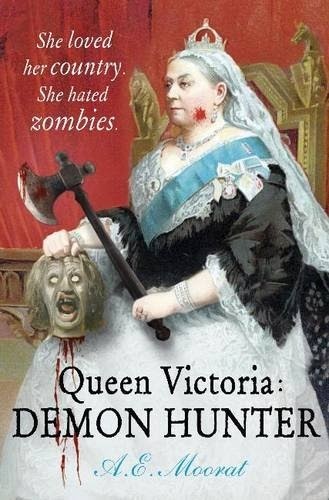
I’ve recently finished Shakespeare Undead, by Lori Handeland, which tells the true story of Will Shakespeare’s lengthy and legendary career.  But the first exposure I had to this twist on History was A. E. Moorat’s Queen Victoria: Demon Hunter.  With the tag line “She loved her country.  She hated zombies.” the book is exactly what you think it will be – a rollicking tromp through Victorian London with a young queen with a penchant for beheading the undead.  It’s a sublime read.  I even recommended my thesis supervisor get his undergrads to read it rather that anything by the unbearably pompous British historian David Cannadine.  The history is solid, and far more enjoyable than anything I’ve ever read by Cannadine.  


Shortly after finishing QV:DH, I found another of Moorat’s works – Henry VIII: Wolfman, which explained so much about Bluff King Hal.  Those mood swings he was so famous for in later life?  Not syphilis; he was bit by a werewolf – he couldn’t help himself.  Moorate took a lot of liberty with history in this work, but even I forgave him for it.  I mean, come on.  Werewolves.  I wasn’t looking for accuracy in this one, folks.

I highly recommend each and everyone one of these books.  And I’m always looking for more.  (I’ve got Sense and Sensibility and Seamonsters sitting on a bookshelf right now, but I want to finish the Austen version first, and I want to reread the actual Tolstoy before jumping into Android Karenina, also sitting on a self in my place.)  This is a genre that I don’t recommend for everyone – you have to be able to laugh at yourself as much as you’ll laugh at the characters to truly get an appreciation for these works.  My hat’s off to the authors who work with these tales, and my thanks to them for bringing it to the world.  

Shakespeare Undead, by Lori Handeland


Today was a stat-holiday in Ontario.  I wanted my paid day off to be fun and pressure free, so I turned to a book a recently picked up that I didn’t expect to be overly engaging, but would rather be a bit of literary junk food.  My choice this morning was Shakespeare Undead, but Lori Handeland.  It was everything I was expecting, and then some!

Handeland’s story is all about the legend that is William Shakespeare.  So many people ask how the Bard was so prolific during his life time, where his ideas came from, and what he was really like.  Handeland’s tale enlightens us: in reality, Shakespeare (or, rather the being that took the name Will Shakespeare from a mugging victim) is a centuries-old vampire.  Before he was turned, Will was a necromancer – one who communed with the dead.  The result is that, when we meet him in 1592, Will has a popular reputation for being a brilliant writer and actor, whose works seem divinely inspired, but in reality, are stories given to him by the ghosts who visit and want their tales told.  I like odd-ball history, and Handeland delivers.

The main story around which the book revolves is the growing relationship between Will (who likes to hunt zombies in his down-time), and Katherine (who was trained to hunt zombies by her voodoo-priestess nanny as a child).  The relationship between Will and Kate (and, if you check the copyright date on this sucker, I’ve got to believe the Royal Wedding inspired Kate’s name selection) is intense and passionate, but is shadowed by the secrets Will feels he must keep from Kate, and the zombie menace that is haunting Elizabethan London.  It’s almost like Twilight in some ways, but less nauseating and more refined.  Propos to Handeland for that.  And it’s a lot like the flick Shakespeare in Love.  But with zombies.  So it’s different enough.  

This book is a quick read.  Handeland’s pacing is marvelous.  While her chapters are short, there is a seamless transition between them that makes you want to keep reading.  There are some minor pacing issues closer to the end, however.  It seems that in an effort to flesh out the growing relationship between Will and Kate, Handeland sacrificed the plot development nearer the end; it’s almost as if she jumps from point A to point C, while blowing by point B.  However, as both points A and C are clever, well written and enjoyable, it’s not a real hardship.

What really makes this work shine is the ingrained sense of humour buried in the story.  Will, a master of words, is quick, clever and a bit of a smart-ass.  Kate is even quicker, more clever, and a full-blown smart ass.  They make a great pair.  Those with a passing knowledge of Shakespeare’s works will recognize the inspirations for his plays Othello and Romeo and Juliette in Handeland’s narrative; they’ll recognize characters from history like Kit Marlowe; and they’ll recognize characters from his plays like Juliette’s Nurse.  Even more comical is the passing inspirations that come to Shakespeare that only the modern reader would recognize – at one point, Will laments ‘seeing dead people,’ at another point, Kit assures him that “You’re our only hope, Will Shakespeare.”  Handeland weaves the past and present together is comedy, tragedy, and a brilliant mix of the two.

This book has everything you’d need – love, danger, and zombies.  I’m extremely glad I picked it up and spent my morning reading it.  I’ll be checking out Handeland’s other works shortly, and am sure I’ll be adding her to my rotation of regular authors.  Final verdict?  Read Shakespeare Undead!  It’s great! 

Saturday, February 18, 2012

Animal Farm, by George Orwell


(*Readers be warned: there are spoilers in this review.  You should all have read Animal Farm by this point in your lives, so I’m not holding back.*)

Is there any author better at writing a scathing indictment of human society than George Orwell?  A lot of the time, I think not.  Orwell is best known for two works: 1984 and Animal Farm.  Both are dystopian fiction, and both are haunting in nature.  While I would dearly love to spend time writing about 1984, the topic of this review is Orwell’s other tour de force – Animal Farm.

I first read Animal Farm when I was 13 or 14.  I remember at the time being conscious of the Community under-tones, but I had yet to read 1984, so I was just being introduced to Orwell’s mastery of the dystopian technique.  Animal Farm is the story of the Manor Farm, the stereotypical English estate; however, the Manor farm is run by Mr. Jones, a drunk, and his band of lazy and uncaring farm-hands.  One day, after having not been fed, the animals revolt against the humans and drive them from the farm.  What follows is a period of contentment and cooperation, followed by regime change, followed by a return to the way things were.

I don’t know Russian history very well, so I’m not going to get the names right, but I do recognize the pattern of the 1917 Revolution in this book.  Orwell was a complex person, but I do know that he was a humanist who was deeply affected by the changes in pre-war Europe; Animal Farm reflects his personal experiences and beliefs on those events. 

Like all satire, there are multiple layers of metaphor and illusions in this work.  The most telling is role of the pigs on the farm.  Being cast as the smartest of the animals on the estate, the pigs are the only ones who can read and write well and who are able to strategize.  Very quickly into the Revolution, the pigs become the political power.  There are two factions led by Snowball and Napoleon.  Snowball is idealistic and, while he does take advantage of his power, he is working to better the lives of the animals.  Napoleon, however, is only interested in power.  (See?  Very Russia 1917.)  The names are clever: Snowball is trying to improve the lot of the animals for idealistic reasons – snow is white, and colour often associated with purity, even though snowballs can hurt.  Napoleon is the perfect name for the villain of an English tale – stepping beyond the obvious fact that England trounced Napoleon completely in 1815, Napoleon was also a johnny-come-lately to the power structure of Revolutionary France and had no real authority to set up an Empire on the backs of the French people.

While the pigs are in charge, aided by the dogs as a kind of brown-shirt force (and yes, I know I’m mixing my fascist metaphors now), the rest of the animals are cajoled, fooled and otherwise duped into believing that they are happy and that the Revolution was a successes and what they wanted.  When the pigs begin placing themselves above the other animals, the porcine spokes-pig, Squealer, offers excuses, explanations and rational which Dick Cheney would be proud of.  One of the tenants of the Revolution, that all animals are equal, was re-crafted to read that “All animals are equal, but some are more equal than others.”  (You have undoubtedly heard that saying in the real world: much like the use of ‘Big Brother’ and ‘2+2=5’ from 1984 have become part of our zeitgeist, Orwell’s Animal Farm made contributions as well.)

Throughout the book, the reader becomes more and more uncomfortable with the changes enacted by Napoleon (who, btw, drives of Snowball and makes him the scapegoat for all ills experienced on the farm) as it becomes clearer and clearer that the pigs are abusing their power and forgetting the driving force behind the Revolution. 

In the final and worse act of breaking the faith with their fellow animals, the pigs redraft the Revolution’s slogan of “Four legs good, two legs bad” (chanted mindlessly at the drop of a hat by, who else, the sheep) to “Four legs good, two legs better.”  Under the guise of needing supplies the farm cannot produce, the pigs then break more tenants of the Revolution and commerce with man and accept paper money.  One evening, the non-pigs of the farm, hearing a ruckus in the farm house, peer through the windows to see the pigs drinking and playing cards with the men from the neighbouring farms.  The closing line of the book speaks eloquently to the situation and, in its role as a metaphor, to the Communist reality:

The creatures outside looked from pig to man, and from man to pig, and from pig to man again; but already it was impossible to say which was which.

The message of dystopian reality is clear: all Revolutions will eventually return to the point where they began.  Orwell plays the dystopian author’s best card – he leaves his reader without hope. 

So, final verdict?  Read this book.  Quite frankly, if you haven’t already, I don’t know what’s been stopping you.  Clever, complex and haunting, Animal Farm is a piece of our Western literary heritage that can’t be ignored and should be read by one and all.  Once you’ve finished with this one, read 1984 (or read it again, as the case may be).  Both works are amazing, and illustrate why Orwell is one of the best at his craft.